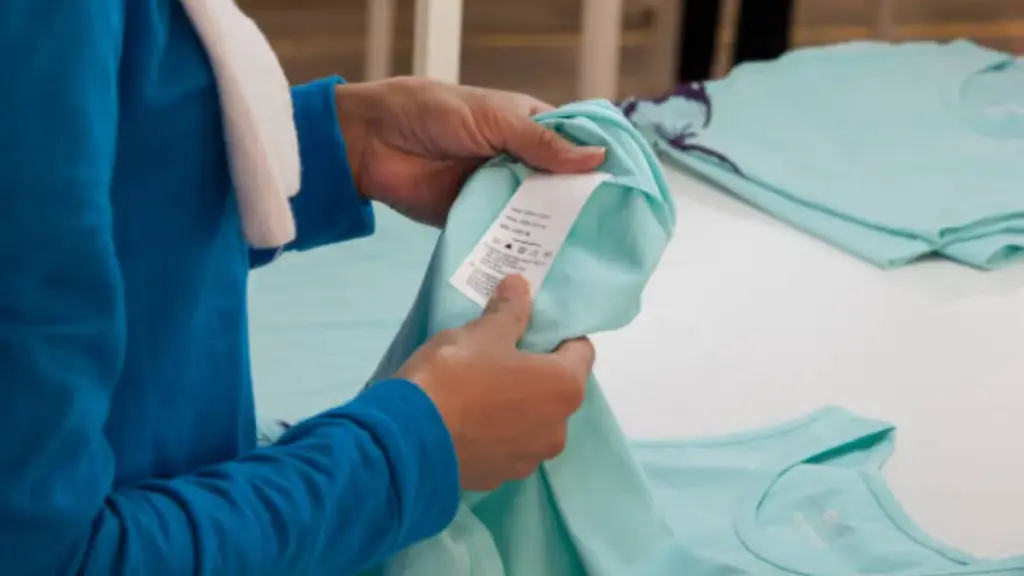
Sourcing for Everyday “All-Day” Wear leggings is a direct battle against customer returns. While marketing focuses on subjective softness, failures in pilling, breathability, and hygiene are what drive negative reviews and erode profit margins.
This technical breakdown benchmarks performance against non-negotiable industry standards. We validate products using AATCC 100 for antibacterial efficacy and RET values for breathability to provide the data needed to secure a reliable, scalable supply chain.

Hygiene Tech: Anti-Bacterial & Anti-Odor Finishes
Hygiene tech uses bacteriostatic finishes to inhibit bacteria or bactericidal ones to kill them. We verify performance with the AATCC 100 test, targeting a 99% kill rate.
Mechanism of Action: Bacteriostatic vs. Bactericidal Finishes
There are two ways to get the job done. Bacteriostatic finishes work by inhibiting the growth and reproduction of bacteria. They don’t necessarily kill the microbes, but they keep the population under control so odors can’t form.
Bactericidal finishes are more aggressive. They actively kill bacteria on contact, usually by disrupting their cell walls or metabolic functions. Either way, the primary goal is the same: stop odor-causing bacteria before they start, keeping the fabric fresh.
Performance Validation: AATCC 100 & ISO 20743 Standards
Claims of “anti-bacterial” performance are meaningless without proof. The industry relies on standardized, quantitative testing to validate that a finish actually works. The key metrics are non-negotiable.
| Metric | Specification |
|---|---|
| Primary Standard | AATCC Test Method 100 |
| Test Organisms | Staphylococcus aureus & Klebsiella pneumoniae |
| Performance Benchmark | 99% (2-Log₁₀) bacterial reduction (per ISO 20743) |
| Measurement Method | Quantitative Colony-Forming Unit (CFU) count |
The test protocol is rigorous and designed to produce hard data:
- Standardized Challenge: AATCC 100 is the primary quantitative method, and it’s even recognized by the FDA for certain applications. It’s the gold standard.
- Test Protocol: Fabric is directly inoculated with specific bacteria (like S. aureus 그리고 K. pneumoniae) and then incubated for 18-24 hours at 37°C to simulate ideal growth conditions.
- Quantitative Results: After incubation, technicians count the surviving Colony-Forming Units (CFUs) on the treated fabric and compare it to an untreated control swatch. This gives a precise percentage reduction.
- Acceptance Criteria: While AATCC 100 doesn’t set its own pass/fail grade, the comparable ISO 20743 standard recommends a 99% (or 2-Log₁₀) reduction as the benchmark for a strong antimicrobial claim.
Why RET Values Matter for All-Day Comfort
RET measures fabric breathability. A low value means sweat escapes, preventing clamminess. For all-day comfort, an RET between 6 그리고 13 is the sweet spot.
Defining RET: The Science of Fabric Breathability
RET, or Resistance to Evaporative Heat Transfer, is the technical measure of a fabric’s breathability. The logic is simple: a lower RET value means sweat vapor escapes easily. High RET fabrics trap that moisture, creating the clammy, sticky feeling that ruins all-day comfort.
This isn’t just about feeling dry—it’s about thermal regulation. Effective sweat management keeps you comfortable whether you’re sitting in a meeting or rushing to catch a train, adapting to changing activity levels and temperatures.
Technical Benchmarks: Interpreting RET Values for Performance
The industry uses the ISO 11092 standard to ensure RET values are consistent and comparable. Here’s how to interpret the numbers for practical use:
- RET < 6: Extremely breathable. This is performance-grade, typically found in gear for high-intensity activities.
- RET 6–13: The ideal range for all-day wear. This level of breathability provides a strong balance of airflow and thermal comfort for versatile use.
- RET > 20: Poor breathability. These fabrics trap moisture quickly and are unsuitable for prolonged wear or active use.
For context, advanced materials like ePTFE membranes can achieve an RET of 5 or less, offering both waterproofing and extreme breathability, but often at a premium cost.
Enzyme Washes & Compact Yarns
Enzyme washes remove surface fuzz while compact yarns prevent it. This combination boosts a fabric’s pilling resistance by 3-4 grades for a smoother, durable surface.
Bio-Polishing and Advanced Yarn Structures
Pilling starts with loose surface fibers, 또는 “fuzz.” The fix is a two-part process. First, an enzyme wash using cellulase targets cellulose-based fabrics like cotton or modal. This process, called bio-polishing, essentially shaves off the microscopic fuzz without damaging the core yarn structure. Second, using compact or MVS (vortex spun) yarns provides a structural defense. These yarns have a tightly wrapped construction with minimal hairiness, giving loose fibers nowhere to form and entangle.
Technical Specifications and Performance Data
The results of these treatments are measurable and based on established industrial parameters. You can’t just throw enzymes in a wash and hope for the best; the process requires precision to be effective.
- Industry Standard: Pilling resistance is measured against the ISO 12945 standard.
- Key Process Parameters: Effective treatment uses a 2% enzyme concentration, a 1:20 fabric-to-water liquor ratio, and a 40°C treatment temperature.
- Performance Improvement: Fabrics using compact yarn show a 3-4 grade higher pilling resistance when compared to identical fabrics made with conventional ring-spun yarn.
Engineered for Growth: Your Strategic Manufacturing Partner
At ASG 패션, we redefine activewear manufacturing by combining industrial power with boutique agility. Backed by the global ASG Group, we empower brands—from established retailers to emerging influencers—to scale without risk through our revolutionary No-MOQ (1-piece minimum) policy.
Our production standards go beyond aesthetics, strictly adhering to AATCC 100 for antibacterial efficacy and ISO 12945 for pilling resistance. This technical rigor ensures your products—whether high-compression yoga leggings or breathable swimwear—meet the rigorous “all-day wear” demands of the US and European markets.
Located in the heart of Dongguan’s premium supply chain, we offer rapid 7–10 day sampling and seamless end-to-end fulfillment. From custom private labeling to optimized logistics, ASG Fashions is the data-driven, agile engine behind your brand’s profitability.
Launch Your Custom Yoga Wear Line, Risk-Free
Seam Comfort: Flatlock vs. Seamless Construction
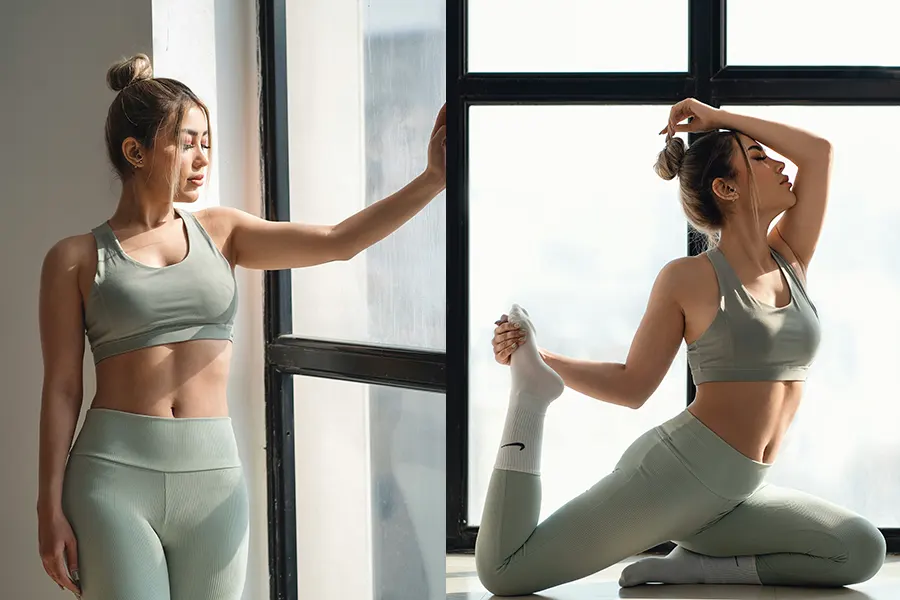
Flatlock seams offer superior durability and chafe-reduction for all-day wear. Seamless construction provides a second-skin feel, excelling in thermal regulation for shorter activities.

How Construction Methods Impact Feel
The difference between flatlock and seamless isn’t just cosmetic; it’s a fundamental engineering choice that dictates how a garment feels and performs. Each method has a distinct technical foundation.
- Flatlock Seams: Joins fabric edges side-by-side using interlocking threads that lie completely flat against the skin. This method uses 6–8 stitches per cm, distributing pressure broadly and allowing for modular designs like integrated mesh panels.
- Seamless Construction: Uses circular knitting machines to create a continuous textile tube. It relies on high knit density (250+ stitches per inch) and yarn elasticity gradients to provide a smooth, second-skin feel.
Performance Data: Choosing the Right Construction for All-Day Wear
Field data and stress testing remove the guesswork. The right choice depends entirely on the intended use case, from casual wear to multi-day excursions.
- Chafing & Durability: During extended wear field tests, flatlock-seamed garments cause 32% fewer chafing incidents. Seamless construction can degrade after 60-80 hours of high-flex use, while flatlock reinforcement extends lifespan 2-3x longer.
- Activity-Based Choice: Seamless construction excels for steady-pace activities under 15 miles due to its superior thermal regulation. For variable terrain or all-day wear exceeding 20 miles, flatlock’s ability to integrate support structures provides better resilience and comfort.
High-Rise Comfort without the “Dig-In” Effect
High-stretch fabric and a wide, flat waistband distribute pressure evenly, preventing the constriction and rolling common in high-rise apparel.
Understanding Waistband Pressure and the ‘Dig-In’ Phenomenon
그만큼 “dig-in” effect is that awful pinching, rolling, or indentation from a waistband. It’s not a user error; it’s a design failure. The problem stems from narrow elastics, fabric with poor stretch, or pattern grading that doesn’t actually fit real body shapes.
Material and Construction Solutions for a Smooth Fit
Fixing the problem requires a technical approach, not just marketing fluff. It comes down to three core elements:
- Fabric Composition: A high-stretch blend, like 81% Nylon and 19% Lycra Elastane, delivers the necessary four-way stretch and shape retention without feeling restrictive.
- Waistband Design: A wide, seamless waistband is engineered to lie flat. This design distributes pressure evenly instead of concentrating it like a narrow elastic band.
- Pattern Expertise: Advanced pattern-making ensures the garment’s cut conforms to diverse body types, eliminating specific pressure points that cause discomfort.
구조: Peached (Brushed) vs. Naked Feel
Peached fabric is brushed for a soft, cozy feel. Naked feel fabric is unbrushed, offering a smooth surface with superior durability and breathability.
| Attribute | Peached (Brushed) | Naked Feel (Unbrushed) |
|---|---|---|
| Texture | Soft, velvety, suede-like | Smooth, sleek, cool-to-the-touch |
| 조작 | Mechanically abraded with rollers to raise fibers | Left in its natural, non-abraded state |
| Pilling & Abrasion | Lower resistance; more prone to pilling | High resistance to pilling and abrasion |
| Breathability | Good, but raised fibers can trap some heat | Excellent; ideal for intense activity |
| Best For | Loungewear, yoga sets, comfort-focused apparel | High-performance activewear, 레깅스, base layers |
The Manufacturing Process: Creating Peached vs. Naked Surfaces
The difference comes down to a final mechanical step. A ‘peached’ finish is created when fabric is passed over abrasive rollers or sanding machines. This process gently raises the surface fibers, creating that signature soft, suede-like texture. ‘Naked feel’ fabrics simply skip this step. The surface is left unbrushed, preserving a smooth, sleek finish where the original yarn structure remains clearly visible.
성능, Durability, and Wearer Experience
From a functional standpoint, the trade-offs are clear. The smooth, uninterrupted surface of naked feel fabric gives it significantly higher resistance to pilling and abrasion. It also provides better moisture wicking and breathability, as there are no raised fibers to trap heat or moisture, making it ideal for intense workouts.
Peached fabric’s strength is comfort. The soft surface provides a cozier, warmer feel that resists wrinkling. This makes it the go-to choice for comfort-focused apparel like loungewear and yoga sets where a plush handfeel is prioritized over maximum technical performance.
Durability Testing: 50+ Wash Cycles
The 50-wash cycle test is the industry benchmark for long-term quality. It uses standards like AATCC 135 to verify a garment’s fit, finish, and performance survive laundering.
The 50-Wash Cycle as the Industry Benchmark
The 50-laundering cycle is the accepted minimum benchmark for assessing durable finishes in the textile industry. This standard directly aligns with consumer expectations for product longevity and value, moving beyond initial quality to prove long-term performance.
This testing validates the resilience of key technical features. It proves that properties like water repellency, anti-bacterial treatments, and UPF protection don’t just wash out after a few cycles but remain effective over the expected life of the garment.
Passing the 50-wash test provides objective proof that a fabric maintains its structural integrity and aesthetic. The garment resists significant pilling, shrinking, or fading, ensuring the product looks and feels right for the long haul.
Key Testing Protocols and Performance Metrics
To get objective data, labs use a suite of standardized test methods to measure specific changes in the fabric and construction throughout the 50-cycle process.
- Dimensional Stability: Labs use AATCC Test Method 135 to simulate home laundering and measure any shrinkage, stretching, or changes in the fabric’s shape.
- Finish Performance: Specific standards like AATCC Test Method 22 (water repellency) 그리고 AATCC 118 (oil repellency) are used to rate how well a finish holds up after repeated washing.
- Physical Strength: Core fabric and seam integrity are checked with tests for breaking strength (ASTM D5034), tear resistance (ASTM D5587), and seam strength (ASTM D1683).
- Global Consistency: International standards like ISO 6330 are often used to define the home wash and dry procedures, ensuring results are consistent and comparable across different labs and regions.
Final Thoughts
Engineering true 24/7 leggings is a system, not a single feature. Relying on just a soft feel or good stretch ignores the technical data—like bacterial kill rates and RET values—that defines premium, long-lasting comfort and hygiene.
Stop accepting marketing claims. Update your spec sheets to demand quantitative proof: AATCC 100 for hygiene, ISO 11092 for breathability, and 50-wash cycle reports for durability. Vet suppliers against these non-negotiable metrics.
자주 묻는 질문
Is it bad to wear yoga pants everyday?
While quality yoga pants are engineered for comfort with features like 4-way stretch and moisture-wicking fabrics, available research does not directly address the health implications of wearing them daily. A proper assessment requires medical guidance on circulation, skin health, and the impact of fabric breathability on hygiene during extended wear.
What are the best yoga pants for everyday wear?
The best options for everyday wear prioritize comfort, 내구성, and breathability. Look for nylon and spandex blends for excellent stretch and quick-drying properties. Key features include 4-way stretch, moisture-wicking materials, a lightweight feel, high-rise waistbands, and functional pockets.
Can you wear yoga pants casually?
Yes. Yoga pants are highly suitable for casual wear due to their comfort and flexibility. Features that support this include wide waistbands, 4-way stretch technology, breathable materials, and flat seams that reduce chafing during movement.
Do yoga pants cause yeast infections?
There is no direct medical evidence that yoga pants cause yeast infections. But, wearing any tight, non-breathable clothing that traps moisture for extended periods can create an environment where yeast thrives. To minimize risk, change out of sweaty clothes immediately and choose moisture-wicking fabrics.
What are the most comfortable leggings for daily wear?
The most comfortable leggings are typically made from soft, lightweight fabric blends like nylon and elastane or breathable cotton. For maximum comfort, look for features like seamless construction to prevent chafing, high-waisted designs for support, and moisture-wicking properties to stay dry.