Swimwear manufacturing involves several stages, from initial design development and fabric selection to cutting, шитье, quality inspection, and final packaging. Stretch fabrics, specialized construction techniques, and fit requirements all influence how each stage is carried out.
This article follows the swimwear manufacturing process from start to finish, covering pre-production, material preparation, cutting and sewing, контроль качества, и отделка. Each stage explains the main production steps and the factors involved in turning a swimwear design into a finished product.
Swimwear Manufacturing Process at a Glance
Ten stages take a swimsuit from design file to shipped carton; here is the full sequence at a glance.
Every swimwear order moves through the same sequence of stages, and each stage has its own approval gate. Skipping a gate — most often the sample approval — is the fastest way to delay a bulk order:
- Дизайн & tech pack — the design is converted into specifications the factory can execute.
- Pattern making — initial patterns are drafted, fitted, and later graded into the full size range.
- Ткань & trims selection — fabric, цвета, принты, elastics, cups, lining, and hardware are confirmed.
- Выборка & fit approval — prototype and salesman samples are made and fitted until the buyer approves.
- Pre-production sample & bulk preparation — the PP sample locks the specification before fabric is cut.
- Резка — fabric is relaxed, laid, marked, and precision-cut.
- Шитье — panels become swimwear through specialized stretch-sewing techniques.
- Quality control — inline checks during sewing, internal final inspection after, and final inspection before packing.
- Finishing & packing — trimming, маркировка, pressing, and retail-ready packaging.
- Final inspection & shipment — the order is inspected against the sealed sample and shipped.
Read on for what actually happens inside each stage, including the checks worth asking your factory about before you place an order.
Pre-Production: From Design to Approved Sample
This phase turns a design into a production-ready specification, and every later stage builds on its output.
Pre-production sampling is where quality is decided. The decisions made here, including fabric choice, pattern accuracy, и подходит, determine what the production line can deliver, no matter how good the sewing is.
Design Requirements, Tech Packs & Pattern Making
A clear tech pack is the single biggest lever a brand controls. The more complete the spec, the fewer sampling rounds you pay for. A usable swimwear tech pack includes:
- Front and back sketches with seam placement and construction callouts.
- A full spec sheet: garment measurements at key points (бюст, waist, hip, rise, strap length, leg opening).
- Fabric and trim codes, including lining and elastic references.
- Stitch types and thread colors.
- The size chart you want graded, including bra cup variants if the style is cupped.
- Tolerances — what measurement variance you will accept.
From the tech pack, the factory’s pattern team drafts the initial pattern, refines it through fitting, and then produces the production pattern. Grading — scaling the base size into the full range — happens at this stage. Swimwear grading has an extra wrinkle compared with general apparel: a bikini with a cup structure needs a two-axis grade (band size × cup size), which is why cupped styles cost more to develop.
Ткань, Colors, Принты & Trims Selection
Swimwear fabric is a stretch engineering problem, not just a material choice. The core families you will choose between:
- Nylon/spandex blends (typically 80/20 или 78/22): the workhorse of swimwear — soft hand, good recovery, strong color saturation.
- Polyester/spandex blends: stronger chlorine resistance for training and performance lines, though with a drier hand.
- Recycled nylon blends (such as 85% recycled nylon / 15% elastane): the default for sustainability-positioned collections.
- Lycra® and similar branded elastane: selected when a brand wants named fiber content for marketing or performance claims.
Colors are either matched from stock fabric or custom-dyed. Custom colors are matched to Pantone references and confirmed on a lab dip before bulk — allow time for this step in the calendar. Prints are applied through sublimation for polyester or digital and rotary printing for nylon, with placement prints requiring pattern alignment during cutting.
Trims matter as much as fabric in swimwear. Elastics (waistband, leg, neckline), rings and sliders, moulded cups, underwire, powermesh lining, drawstrings, and labels all need to be specified with exact widths, composition, and colors. A factory with its own trim library saves weeks of sourcing.
Выборка, Fit Testing & Sample Approval
Sampling follows a fixed sequence. Understanding it helps you read your factory’s timeline:
- Разработка / prototype sample — first physical version, made to check the pattern and general look.
- Fit approval — fitted on a model or fit form against the spec; changes are fed back into the pattern.
- Salesman sample — a refined version in the final fabric and colorway, used for your own selling or line reviews.
- Pre-production (PP) sample — made in the actual production fabric with final trims; this is the reference standard for bulk.
- Вершина / shipping sample — pulled from the first bulk output to confirm the line matches the PP sample.
Timeline note: a focused swimwear factory should turn a sample in 7–10 дней, against an industry norm of 20–30 days. Sample fees are a normal part of the process — a common policy is $50 per style, refunded against the bulk order. If a factory quotes you free unlimited sampling with no development process, treat it as a warning sign, not a perk: real pattern work costs money, and someone is paying for it somewhere.
Related: our B2B swimwear sourcing guide covers the buyer-side workflow in more detail.
Bring Your Swimwear Designs to Production
From tech pack development and fabric selection to pattern making, выборка, контроль качества, and bulk production, ASG supports swimwear brands throughout the manufacturing process.
OEM & ODM | Custom Designs | Гибкий минимальный заказ
Discuss Your Swimwear Project →Preparing for Bulk Swimwear Production
Before fabric meets the cutting table, three preparation steps protect the order from shrinkage, defects, and specification drift.
Fabric Inspection, Relaxation & Size Grading
Before a single piece is cut, the bulk fabric goes through incoming inspection on a fabric inspection machine: width and weight (GSM) are checked against the order spec, and the roll is scanned for defects, shading, and color consistency between batches.
Inspected fabric is then relaxed — unrolled and rested, typically 24–48 hours — so that it returns to its natural dimensions before spreading. Knit fabrics with spandex “shrink” on the roll; cutting relaxed fabric prevents panels that come out smaller than the pattern after sewing. Any factory that skips relaxation will tell you about it later, through fit inconsistency across the order.
Production Planning and Material Preparation
Once fabric is cleared, the factory holds a pre-production (PP) meeting. The order is allocated to a production line, the cutting plan is prepared, and all required materials, including fabric, lining, elastics, cups, hardware, и этикетки, are issued to the line in the specified quantities.
For orders of up to 1,000 куски, bulk production typically takes about 30 days in a focused swimwear factory. Larger orders and placement prints may require additional time, depending on production complexity and material requirements. The overall timeline from confirmed tech pack to shipment averages approximately 60 дни.
Pre-Production Sample & Specification Confirmation
The pre-production (PP) sample is used to confirm the final product specifications before bulk manufacturing begins. It is made with production fabric, final trims, and the intended construction methods. Both the brand and the factory review and approve the sample, either physically or through an approved specification sheet.
Once approved, the PP sample serves as the reference standard for bulk production. Any subsequent changes to fabric, соответствовать, construction, or trims may affect production costs and timelines, particularly after fabric cutting has started.
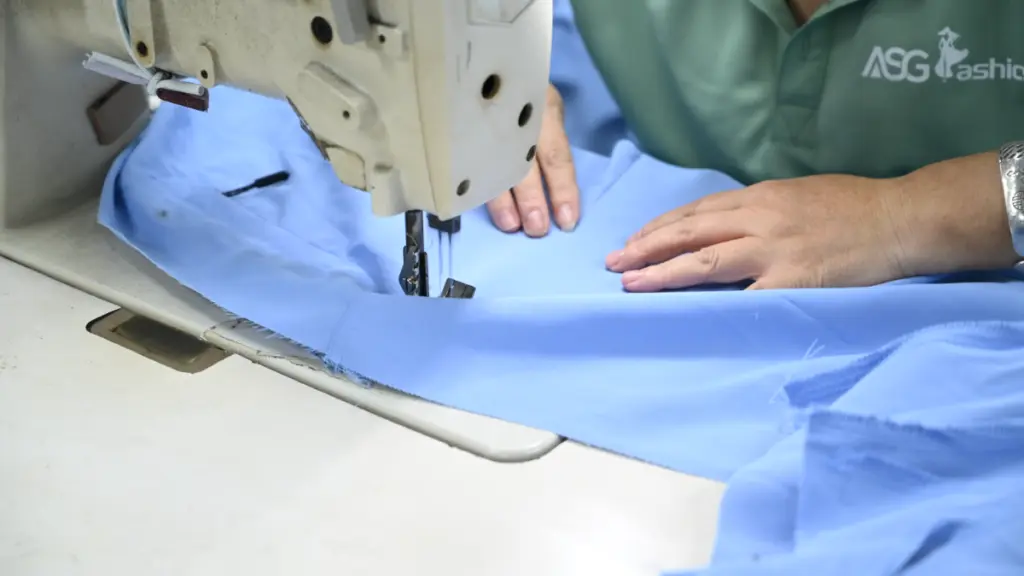
Резка & Шитье: Turning Fabric Into Swimwear
Approved fabric is transferred to the cutting tables, where pattern pieces are cut and assembled using sewing techniques suited to stretch fabrics and swimwear construction.
Fabric Laying, Marking & Точная резка
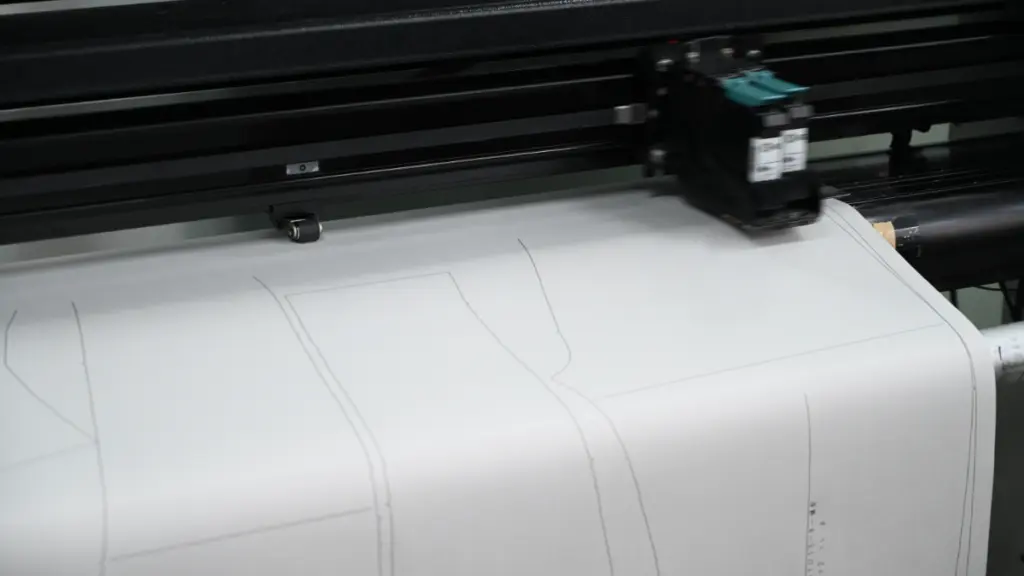
Cutting starts with spreading, where fabric is laid in even, tension-free layers. The marker refers to the layout of pattern pieces on the fabric and is optimized for material efficiency. Since swimwear pieces are small and curvy, marker efficiency directly affects fabric waste and unit cost. Cutting is carried out using straight-knife or band-knife machines. For placement prints, each panel must also be aligned with the printed design.
Specialized Sewing Techniques for Swimwear
Swimwear requires sewing techniques that accommodate fabric stretch and repeated movement. Common methods include:
- Overlock / serging (3-thread and 4-thread): Used for primary construction seams, providing strength and stretch for most internal seams.
- Flatlock stitching: Creates flat seams that reduce bulk and friction. It is commonly used in high-abrasion areas and reversible or seamless-look styles.
- Zigzag and stretch straight stitches: Used for seams that need to retain elasticity during wear.
- Coverstitch and double-needle topstitching: Used for elastic application, hems, and decorative stitching while maintaining stretch.
- Ballpoint needles: Designed for knit fabrics, these needles help prevent skipped stitches, damaged fibers, and fabric laddering.
Elastic application is another important part of swimwear construction. Different methods are used for elastic under tension, covered elastic edges, and picot trims. Incorrect tension or inconsistent application can cause puckering, uneven edges, or reduced garment recovery.
Elastic, Straps, Cups & Lining Construction
Swimwear construction also involves several components that affect fit, поддерживать, и комфорт:
- Elastics: Applied at waistbands, leg openings, and necklines with controlled stretch ratios to provide a secure fit without excessive pressure.
- Straps: Formed or cut to the required dimensions, reinforced at attachment points, and adjusted according to the size grade.
- Moulded cups: Inserted into shaped pockets or bonded into place. Underwire styles also require a casing with finished wire ends.
- Lining: Materials such as powermesh or nylon tricot are attached as an additional layer to improve opacity, поддерживать, и комфорт.
These components require consistent measurements and application tension. For example, a strap that is 10 mm shorter than the specified length can affect fit and support. Differences in elastic tension or cup placement can also cause inconsistencies between finished garments.
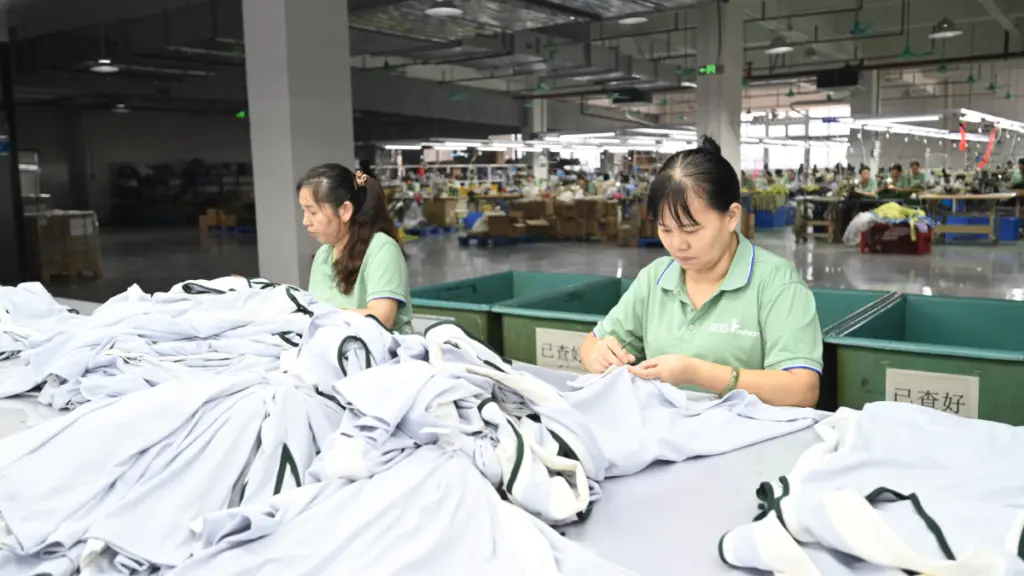
Quality Control Throughout Swimwear Manufacturing
Swimwear fails in predictable ways — stretched-out fabric, broken straps, skipped stitches — and quality control exists to catch each one.
Inline Inspection vs. Final Inspection
Swimwear factories run two layers of inspection:
- Inline inspection happens on the line, station by station, while the garment is being sewn. Inspectors check for skipped stitches, dirt and stains, fabric damages, and construction faults at the moment they occur — when they are cheapest to fix.
- Final inspection happens on the finished garment: an internal final inspection after sewing, and a separate final inspection against the sealed PP sample before packing. Measurements, appearance, and workmanship are checked against the approved standard, either 100% or by AQL sampling depending on the order terms.
Ask your factory what their inline-to-final ratio is. A factory that inspects at the end only finds faults too late; a factory that inspects throughout rarely lets them reach the end.
Swimwear-Specific Quality Checks: Stretch, Recovery & Colorfastness
Swimwear has failure modes general apparel does not. The checks that matter:
- Stretch and recovery: fabric is stretched and released repeatedly to verify it returns to shape — the difference between a swimsuit that bags out after a season and one that does not.
- Colorfastness: to washing, to light, and for performance lines to chlorinated water — prints that bleed in the first pool session are a recall-grade problem.
- Dimensional stability: garments are measured before and after washing to confirm the size you approved is the size that ships.
Beyond these, responsible factories send garments for independent testing — garment testing, lead content, flammability, and phthalates are the standard battery for swimwear exported to the US and EU. When you vet a factory, ask to see recent test reports; and for children’s swimwear, verify CPSIA (US) and EN 14682 cord-and-drawstring (EU) compliance as part of your own due diligence.
Seam Strength, Эластичность & Fit Consistency
Two mechanical checks round out the QC system:
- Pull testing on a pull test machine — straps, closures, and attachment points are pulled to verify they hold under load. A strap that fails the pull test fails the product.
- Needle detection — every finished garment passes through a needle detection machine before packing, so no broken needle fragment ships inside a garment, and a needle detection report accompanies the order.
Combined, these checks are what “the factory has QC” should actually mean. For a fuller checklist, see how to evaluate a swimwear manufacturer’s quality system.
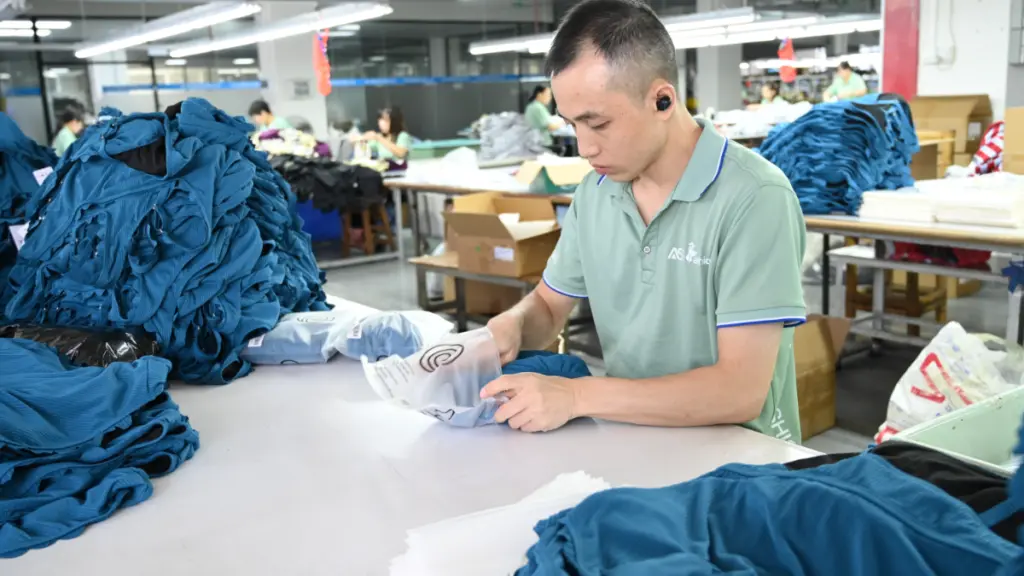
Finishing, Упаковка & Preparing for Shipment
Sewn and inspected garments enter the final stage: trimming, маркировка, упаковка, and the last check before they ship.
Final Trimming, Labeling & Compliance Requirements
Finished garments are thread-trimmed, pressed where the fabric allows, and labeled: main label, care label (fiber content and country of origin are legally required in most destination markets), and your hangtag if you use one. Label content — fiber composition, care symbols, origin — should be finalized in the tech pack stage, because it is printed against your order and mistakes are expensive to correct after packing.
Compliance is destination-specific. For the US and EU, buyers are responsible for verifying fiber content labeling rules, flammability standards for the garment type, and — for children’s lines — the stricter safety regimes. Your factory should be able to support the testing; verifying the certificates is the buyer’s job.
Retail-Ready Packaging & Order Preparation
Packaging is specified per order: individual polybagging, folding method, size/color ratio per carton, and carton marking. If you sell through retail or marketplaces, specify retail-ready packaging (hangtag placement, fold direction, polybag print) in the tech pack — retrofitting it after production adds cost and handling time.
Final Inspection Before Shipment
The last gate: final inspection against the sealed PP sample, covering measurements, appearance, маркировка, и упаковка, plus the needle detection report. Only after this passes does the order move to shipment, accompanied by the commercial invoice, packing list, and any destination-required documents.
Заключительные мысли
The swimwear manufacturing process involves multiple stages, from design development and material preparation to cutting, шитье, контроль качества, и отделка. Consistent specifications, accurate pattern measurements, and controlled construction methods help maintain product quality throughout production. A confirmed tech pack and approved PP sample also provide clear references for bulk manufacturing.
АСГ Мода provides OEM and ODM swimwear manufacturing services, with a 3,200 m² factory, three production lines, 7–10-day sampling, and a 300-piece MOQ. Brands interested in custom swimwear production can contact our team for project inquiries.
Часто задаваемые вопросы
How long does the swimwear manufacturing process take?
Sampling takes 7–10 days in a focused swimwear factory, compared with the industry norm of 20–30 days. Bulk production for orders of up to 1,000 pieces takes approximately 30 дни. From confirmed tech pack to shipment, the full production cycle averages around 60 дни. Brands should plan their orders accordingly to meet seasonal launch deadlines.
What is the MOQ for custom swimwear?
The minimum order quantity (минимальный заказ) for custom swimwear starts at 300 pieces per order, below the common industry benchmark of 500 куски. The exact quantity can be negotiated depending on the project. This MOQ makes custom production more accessible for new swimwear brands while maintaining the efficiency of bulk manufacturing.
Can I customize fabric, цвета, and prints?
Да. Custom swimwear can be made with different fabrics, including nylon, polyester, Лайкра®, and recycled nylon blends. Colors can be matched to Pantone references, while placement prints and all-over prints are also available. Both OEM (your own designs) and ODM (existing manufacturer designs customized with your branding) services are offered. Learn more in our OEM vs. private label swimwear guide.